Nick Allison
Back in February, ahead of the primaries, Alex, a younger friend of mine, told me the election would be his first time voting. He was a little nervous, he said, because he didn’t really know what to do or what the process was like, and he asked if I could help him figure it out. I told him yeah, of course, without hesitating. That’s what I said out loud, and I meant it, but I’ll admit my internal monologue was a lot less generous and a whole lot more judgmental, a mix of disbelief and disappointment.
Dude, you’re almost thirty, how have you never voted?
You’ve been eligible for three presidential elections and at least two midterms...
You’re nervous? You’re casting a ballot, not performing open-heart surgery!
This is how we got to this point in the first place...
I’m not exactly proud of where my mind went, not that I had a lot of say in the matter. I’m a writer, not a fully enlightened Buddha. I can’t control my thoughts before they happen, but I have (mostly) learned to recognize thoughts as just thoughts, objects that appear in consciousness. We get to choose whether to listen to them, or to push them aside as the mostly meaningless judgments and emotions they usually are and get to the work of being useful instead.
And I should probably cut myself some slack too. Anyone who has spent the last decade watching this country slide in the authoritarian direction it’s been sliding has probably done the same math in their heads, looked at the turnout numbers and all the people who decided to stay home on Election Day for whatever reason, and felt something a lot closer to anger than empathy. I get that impulse, but I’m not so sure being judged has ever gotten a single person to the polls who wasn’t already going.
So I sat down and wrote Alex an email with step-by-step instructions, what to bring, what to leave at home, what to expect when he got there, the kind of stuff that seems obvious to anyone who has voted before but can be intimidating to a first-time voter. We all had to learn it at some point. I threw in my own thoughts on who I was voting for and why, which seemed fair. It’s campaign season after all, and I already suspected our positions mostly aligned. I helped him look up his registration and confirm he was good to go. Fast forward to primary day, and after he voted he told me he’d printed out the email and carried it with him as a guide, that he’d found it useful and comforting, and he looked proud of himself, as he should have.
I have to check myself on this shit sometimes. It’s easy to slide into judging younger people and writing off an entire generation as hopeless and helpless, and it’s about as accurate as it is useful. My son turned 18 last year and voted for the first time in that same primary. My daughter is 13 and will be right behind him in a few years. Neither of them is hopeless or helpless, far from it in fact, and they’re a big part of why I catch myself when that judgment kicks in. Being written off is about the worst motivator there is, and I’d hate for anybody to do it to them.
Helping Alex stuck with me (or more accurately, catching my own knee-jerk judgment and choosing to be useful instead stuck with me) so I decided to keep at it and signed up for VDR (volunteer deputy registrar) training. Over the spring and summer I volunteered some with Powered by People in Central Texas, though not nearly as often as I’d have liked. With kids and family and a career there’s only so much spare time for sitting on a college campus behind a folding table and a stack of registration forms. Plenty of other volunteers put in far more hours than I did, many of them young, many of them retired, all of them out there doing the important work of informing and registering new voters.
At those tables I noticed a couple things. One was excitement about finally getting to vote, to have a say on some level, maybe the only level where it really counts. The other, though to be fair not from everyone, was the same worry Alex had expressed, a general nervousness about the actual process. We’d always explain that it’s much simpler than it might seem and walk them through it a step at a time. Nobody at those tables was lecturing anyone about the elections they’d missed, because it wouldn’t have helped, and everybody there knew it.
When the general election came around, Alex asked for another guide, since I’d warned him it would be a little different from the primary. This time I skipped the internal monologue and just got to work. If it helped him get to the polls, that was all that mattered. Between Alex, my own kids, and the other first-time voters I’ve talked to, I’ve come to believe there’s no room for that kind of judgment here if we’re serious about repairing the last decade of damage inflicted on this nation by Trumpism. We need these young and first-time voters to show up, and to show up with confidence, and cast their ballots, which may be the most fundamentally American thing an American can do.
Early voting opened in Texas on October 19, and I went that morning before work. It was as simple as always. I always recommend voting early if you can, unless you particularly love standing in long lines. And since I’m trying to practice what I’m preaching here, I’ve adapted the guide I wrote for Alex (the original was specific to Williamson County, Texas) and shared it below, in case anyone else out there is where he was back in February, looking at the direction the country is headed, not liking it, and deciding to take part for the first time. If that’s you, thank you. I mean that.
A Short Guide for First-Time Voters
I’ve only ever voted in Texas elections (once by overseas ballot, from Iraq, when I was still in the Army), so I can’t tell you exactly how it works in your state. Every state runs its own elections, and the rules on registration, ID and early voting vary. I’ve done my best to keep everything here accurate, but double-check the details with your state or local election office before you go. CanIVote.org will point you to the right place. The basic process is the same just about everywhere, though, and none of it is all that complicated.
Check your registration. Go to CanIVote.org, a nonpartisan site built by state election officials that sends you straight to your state’s voter lookup and polling place finder. Do it now, not at the check-in table with a line behind you. If you’re not registered, don’t assume you’ve missed your chance. Around 20 states plus Washington, D.C., let you register and vote at the same time, either during early voting, on Election Day, or both. The site will tell you whether yours does.
Missed the deadline? If you’re not registered and your state doesn’t offer same-day registration, you may be out of luck for this one, but don’t let that be the end of it. Register now anyway. This (probably!) isn’t the last election we’ll ever have… there’s a pretty big one coming up in 2028. Once you’re registered, you generally stay registered. Just update it if you move, and check your status before you vote if it’s been a few years.
Know your ID rules. Most states ask for some form of identification at the polls. Some require a photo ID, and others don’t. Even in those states, first-time voters who registered by mail can be asked for ID under federal law. So look up your state’s rules, and bring your driver’s license or other photo ID either way.
Vote early if you can. Most states offer some form of early voting, and in many places you can vote at any early voting location in your county. The lines are shorter, and you won’t feel like people are breathing down your neck. If something goes wrong, like a registration problem or a forgotten ID, you will have days or weeks to fix it instead of hours.
Bring notes, on paper. Ballots are longer than you’d think, with races from the top of the ticket down to judges and local offices. Vote411.org from the League of Women Voters lets you see your actual ballot and compare candidates side by side. Write down your picks and bring the list. Some states restrict phone use at the polls, so don’t count on pulling up your notes on your phone. If you plan to vote for one party all the way down, a handful of states still offer straight-ticket voting, where one selection marks every candidate from that party. Most states, including Texas, don’t, so you’ll be marking each race yourself. Even where straight-ticket voting exists, it only covers partisan races. Nonpartisan races like school boards, along with ballot measures, don’t list a party, so it’s worth doing a little research on those before you go.
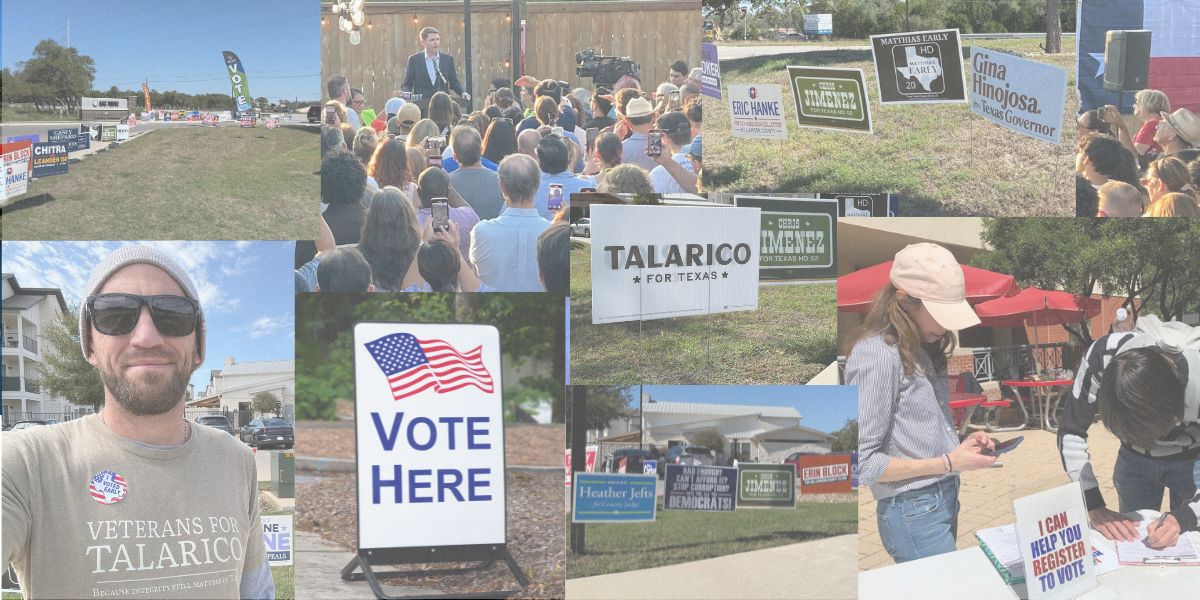
Leave the campaign gear at home, or cover it up. About half the states, including Texas, ban shirts, hats and buttons supporting candidates, parties or ballot measures at the polls, and in some others it’s up to the poll workers. You can look up your state’s rules, but it’s easier to just play it safe. I was wearing my “Veterans for James Talarico” shirt when I voted and just threw a hoodie over it on my way in.
Casting your ballot. I voted in Williamson County, Texas. The details will look a little different where you are, but the basic steps are the same. Follow the “Vote Here” signs and check in with a poll worker. In my case they asked whether I wanted to vote on the machine or use a paper ballot. I went with the machine. They printed my ballot and pointed me to a booth. I inserted the ballot, followed the on-screen instructions, marked my choices, checked the review screen and cast it. The machine printed my completed ballot, and I carried it to the scanner, where another poll worker was standing by, and fed it in. They handed me an “I Voted Early” sticker, and I was done.
If you wait until Election Day. Election Day is Tuesday, November 3. The biggest difference from early voting is where you go. Many places that let you vote anywhere in your county during early voting will send you to your assigned polling place on Election Day, and it may not be the same spot where you voted early or last time. Look it up on CanIVote.org before you head out, because in a lot of states a ballot cast at the wrong location may not count. Hours vary by state, but most polls open early in the morning and close around 7 or 8 p.m. Lines tend to be longest before work, at lunch and right after work, so mid-morning or early afternoon is usually your best bet. Bring everything you need, since there’s no time left to fix a forgotten ID or a registration problem. Many states also require employers to give you time off to vote, though the rules vary and some require you to give notice ahead of time, so check your state’s rules now if your schedule is tight. And if you’re in line when the polls close, stay in line. As long as you were there by closing time, you get to vote.
If something goes wrong. If your name isn’t on the list at your polling place, ask for a provisional ballot. Federal law guarantees you can cast one, and it will be counted if officials confirm you’re eligible. And if you get stuck on anything at all, ask a poll worker. They signed up to be there, and in my experience they’re patient with first-timers.
That’s really all there is to it. In fact, it’s way simpler than the length of this guide might suggest. You’ll be in and out before you know it, with a cool sticker to slap on your shirt or laptop, a small way of telling everyone you showed up, cast your ballot and exercised the right that helps protect all the others. And maybe a friend or two will see it and go do the same.
Nick Allison is a writer and editor based in Austin, Texas. His work has appeared in Slate, HuffPost, The Fulcrum, and elsewhere. He does his level best to avoid all things social media, but you can occasionally find him on Bluesky or follow him on Substack, if you’re into that sort of thing.
Discover more from the chaos section
Subscribe to get the latest posts sent to your email.


