A shorter, edited version of this essay first appeared at HuffPost Personal.
A few hours before the polls closed on Tuesday, I found myself at a local coffee shop, pondering outcomes and tempering expectations. On one hand, I felt better about our chances of finally sending Donald Trump a clear, anti-authoritarian message than I had at any time over the past decade. On the other, I couldn’t ignore the fact that this is Texas, and we hadn’t sent a Democrat to the Senate since 1988 or elected one to any statewide office since 1994.
Over my 46 years, and especially the 30 or so I’ve been paying attention to politics in the state I’ve always called home, those of us who hang out anywhere from the center to the left side of the political aisle have been told, repeatedly and with the evidence to back it up, that a non-Republican simply can’t win statewide office in Texas. It’s impossible, a pipe dream. And the GOP’s latest round of aggressive redistricting ahead of the midterms didn’t exactly improve the mood. Still, I couldn’t help feeling a strange sense of optimism. Not that I was about to jump online and publicly predict a sweeping Democratic victory in Texas or hustle over to one of Don Jr.’s prediction markets and put money on it. But things just felt different this time, and that feeling didn’t come from the cable news pundits or podcast hosts predicting a blue wave, but from the organizing work that’s been happening on the ground here for years, and from the conversations I keep having with regular Texans.
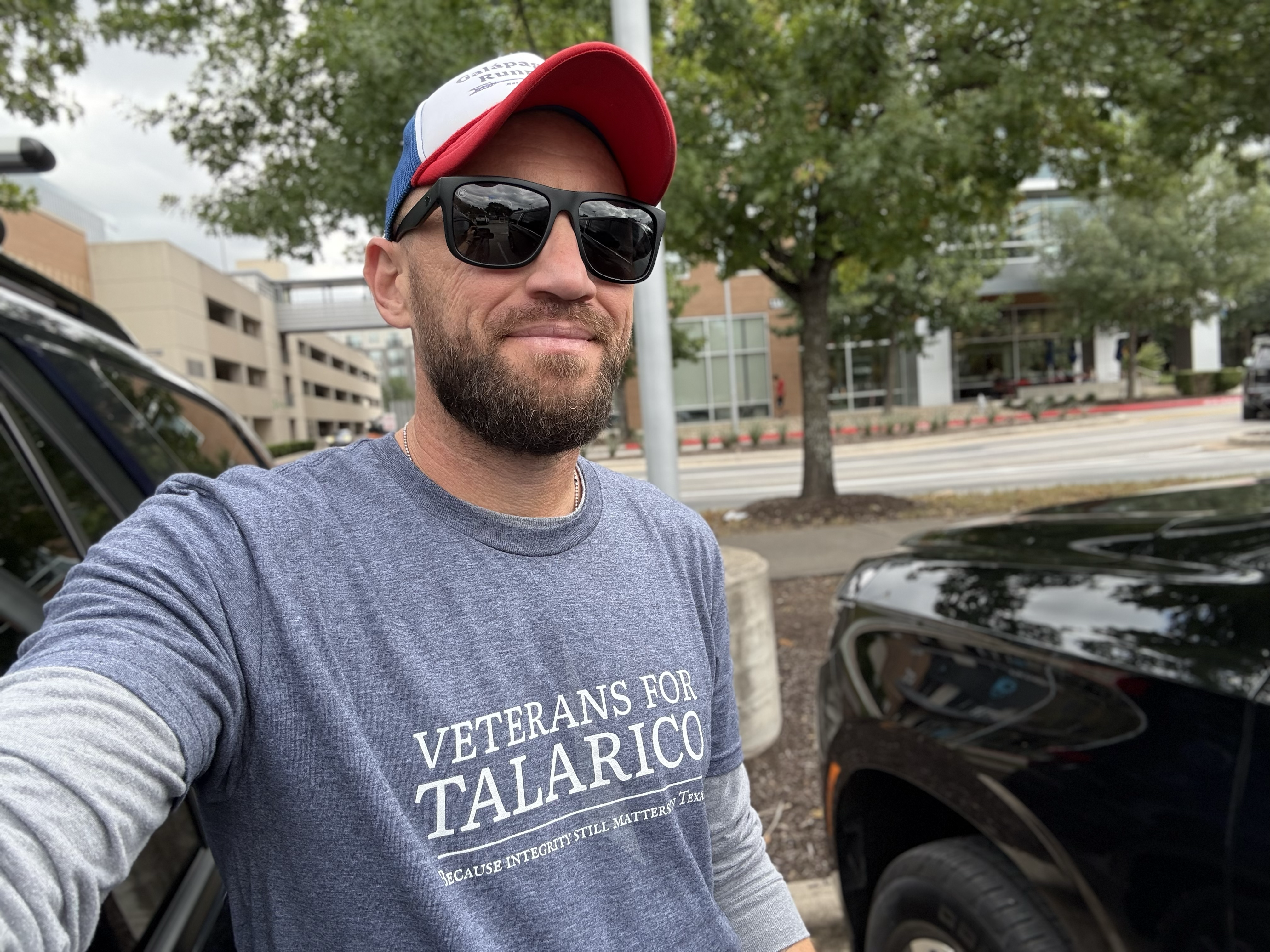
For the weeks leading up to the election, I wore a Veterans for Talarico T-shirt just about every day. I expected my fair share of shitty comments and eye rolls from strangers in deep red Texas, but they never really materialized. A few years ago, any piece of gear promoting a Democrat or criticizing President Trump would have drawn plenty of negative attention. By October, crickets. Well, not exactly crickets, since “crickets” implies silence, and strangers kept stopping me to say they loved the shirt. That gave me the natural opening to ask if they’d voted yet, and the answer was always either “yep, voted early” or “not yet, but I’m definitely going.”
I know there’s nothing scientific about tallying up reactions to a T-shirt in Travis and Williamson counties, but the shirt wasn’t the only reason I felt hopeful. Back in 2018, when Beto O’Rourke came within three points of unseating Ted Cruz, the red wall didn’t break, but it definitely cracked. At the time, most Democrats in the state saw it as one more close call that ended the way it always ends for Democrats in Texas. In hindsight, I can’t see it as anything but a net positive. That campaign built a statewide network of volunteers that didn’t go away when the campaign ended, and after O’Rourke dropped out of the 2020 presidential race, he turned it into Powered by People, a grassroots group focused on registering and turning out voters across Texas.
Before the primaries back in March, I attended training to become a VDR (volunteer deputy registrar) and volunteered with Powered by People a few times over the spring and summer. The PxP model is pretty simple, at least on paper: go out and find people who aren’t registered, get them registered, and then stay in touch with them. Most of that initial contact happens in person, at tables on college campuses and at festivals and concerts. Pretty standard voter registration stuff. But once a new voter is signed up, volunteers use an app on their phones to keep the conversation going. Each volunteer gets a list of a few dozen voters, often the same people they registered themselves, and texts them on a statewide schedule with reminders about registration deadlines, early voting, and Election Day. According to Powered by People, the Texans its volunteers registered and stayed in touch with in 2024 turned out at a 79% rate.
Many of the volunteers were college-aged kids or retirees. As a middle-aged man with a job and kids of my own, I wasn’t able to contribute as much as I would have liked, but luckily there was no shortage of people willing to spend their days under the hot Texas sun talking to would-be voters and getting them registered. Powered by People didn’t do it alone, and plenty of other groups have been grinding away too, but if you want to know how a state that hadn’t elected a Democrat statewide in 32 years finally elected a whole bunch of them, years of unglamorous legwork and grassroots organizing like that is a big part of the answer.
The other reason I was feeling hopeful is that I personally know a lot of people here, and while plenty of them are lifelong Republicans, they’re nothing like Donald Trump. They aren’t cruel or crude or selfish or greedy. They’re good people. Maybe some of them held their noses and looked away from much of the madness over the past decade (and that obviously has consequences), but they didn’t embrace it. These aren’t the kind of people who would cheer on masked, undertrained thugs cosplaying as soldiers while they rounded up their neighbors based on the color of their skin. They don’t like seeing the Constitution trampled, regardless of which party is doing the trampling. And they certainly don’t appreciate being lied to by a president who stormed back into office on promises to fix the economy and stay out of new wars, only to tax American consumers through tariffs and promptly start a new war, all while slapping his name in gold leaf on everything and personally profiting to the tune of billions from his office.
Several of my Republican friends even told me they were planning to vote for a Democrat for the first time in their lives. They talked about how much they liked James Talarico and respected him for focusing on issues that actually affected them instead of getting dragged into the mudslinging. But even after hearing all of that from Republican friends and family, and even though I was secretly feeling hopeful after the groundwork I’d seen and the interactions I’d had in my Veterans for Talarico shirt, a big part of me still didn’t believe any of it would matter. History would just keep repeating itself in the Lone Star State, no matter how good the Democratic candidates were, how bad the Republican candidates were, or how blatantly corrupt and out of control Trump got. Texas is a red state.
And then, suddenly, it wasn’t.
I can’t really say I woke up to a new blue state Wednesday morning, since that would suggest I’d gone to bed. My wife was flying out early that morning to visit her parents, and I had to be up around 2:30 a.m. to drive her to the airport. Sometime between watching the red wall in Texas collapse one brick at a time and waiting on results out of Michigan, I realized it was well after midnight and I’d probably be better off just staying up.
I wasn’t really surprised that Talarico beat Ken Paxton for the Senate seat (though I wouldn’t have gambled on a 13-point margin), but the rest of the state’s results were another story. Vikki Goodwin took down Dan Patrick in the lieutenant governor’s race. Democrats flipped the state House. Democratic state Sen. Nathan Johnson won the attorney general’s race. Comptroller, railroad commissioner, agriculture commissioner, it just kept going. But maybe the biggest surprise of all was Gina Hinojosa, a state representative who was barely known outside of Austin, beating three-term Republican Gov. Greg Abbott, and not just beating him but doing it soundly, to become the first Latina governor in Texas history and the first woman and first Democrat to hold the office since Ann Richards.
I don’t believe all my fellow Texans suddenly became progressives overnight. This election was quite obviously a referendum on the many failures of the Trump regime and the spineless Republican politicians who chose, time and time again, to side with Donald Trump over their own values. People were so fed up with the lies, the lack of checks on executive power, and the skyrocketing costs from tariffs and war that they were willing to give the “other side” a chance to clean it up. What that means for Democrats is another essay for another, more qualified author to write. All I’m really qualified to talk about is what I saw with my own eyes, and what I didn’t see: the blind spots and biases in my own vision.
I’ve written before about an encounter with a white, middle-aged, tattooed police officer who saw my Veterans Against Trump shirt and started walking toward me. I assumed I was about to get into an argument, and instead he gave me a fist bump, thanked me for my service, and said he liked the shirt. That wasn’t the only interaction like that I’ve had, far from it, and yet I keep falling for the same biases and stereotypes I’ve built up in my head. Every time I run into someone from the same demographic as that officer, some part of my brain assumes he’s a Trump supporter. Which is funny, because middle-aged, white, tattooed, bearded Texas guy looks a lot like what I see in the mirror every morning.
A few days before the election, I was at Lioness Books, a woman-owned independent bookstore in Leander, dropping off a box of books for the owner, Sarah Ambrus. My co-editor Rachel and I had just finished editing and publishing Uprooted: Poems of Resistance, Witness, and Survival, our third protest poetry anthology, and Lioness has carried all three. While I was there, I mentioned to Sarah how much I’d loved a poem called “Our National Anathema” by a poet named Biff Rushton. In his submission email, Biff had mentioned that “Sarah at Lioness” was the one who encouraged him to submit something to the project. When I brought that up, she asked if I wanted to meet him, since he was only about 10 minutes away. Of course I did. When he walked in, my first thought was: “Well, if I’d seen this guy in public with no context, I’d have filed him away as a Trump supporter, too.” He was anything but. This was the guy, after all, who wrote one of my favorite protest poems in a book full of protest poems aimed very specifically at the Trump administration. We talked for a while about literature and the election and expectations, and we both landed in about the same spot. Cautiously optimistic, but not overly confident.
I know how ridiculous it is to mentally lump people who look exactly like me in with MAGA when I’m certainly not MAGA myself. It’s funny how I’ve convinced myself just how open-minded I am. And I do try. But like most of us, I still walk around filing people into neat little stereotypical groups without even thinking about it.
After Texas flipped, I wanted to know more about what had actually happened, and whether my stereotypes held any water, so I went digging through The New York Times’ Voter Trends data. Some of it let my snap judgments off the hook. Sixty-three percent of white men who voted in the U.S. Senate race in Texas still went for Paxton. So did 56% of white women voters. White voters in general between 45 and 64, the demographic I’m now a part of, went Republican 64% of the time. So the part of my brain that files every bearded, middle-aged white dude away as part of the problem turns out to be statistically correct two out of three times. But there was good news in the numbers too. White men moved 18 points to the left compared with how we voted in the 2024 presidential election. And one out of three is still a lot of people I’m getting wrong.
The bigger story might be less about how white people voted and more about how everyone else did. Hispanic Texans make up about 40% of the state’s population, and the fatal error Republican strategists made was assuming that after 2024, those voters belonged to them. Instead, Hispanic voters swung 46 points and went for Talarico 72% to 27%. Turns out people who gave you a shot at fixing the economy aren’t going to be cool with you immediately making everything worse and then sending stormtroopers into their communities to disappear their friends and relatives. The newly elected Democrats would do well to learn from that and keep their focus on the reasons people put them in office, and not take any demographic, working class or otherwise, for granted.
Maybe the most encouraging number of all: people who didn’t vote at all in 2024 made up about 15% of the electorate and broke for Talarico by more than 40 points. Those are exactly the folks Beto and his army of volunteers have been out there educating and registering for years. And the day after the election, they were already getting back to work, signing people up for 2028.
The wave that swept across Texas was definitely blue and definitely huge, but that doesn’t mean the entire state became Democrats overnight. People on the left who were angry showed up. Some people on the right who were angry stayed home. Some who were pissed enough switched sides. First-time and young voters showed up. People changed their minds, a lot of them, in every group, including about a third of the guys who look like me.
But driving home from the airport Wednesday morning, I didn’t know any of that. It’s not often that I pull all-nighters these days, and the exhaustion was starting to creep in, but I felt strangely energized at the same time. As I pulled into the driveway and headed inside to wake the kids up for school, I looked to my left and saw that the sun was just starting to show itself as a thin purple line on the eastern horizon.
Nick Allison is a writer and editor based in Austin, Texas. His work has appeared in HuffPost, Slate, CounterPunch, The Fulcrum, and elsewhere. He does his level best to avoid all things social media, but you can occasionally find him on Bluesky or follow his mostly nonpolitical Substack, if you’re into that sort of thing.
Discover more from the chaos section
Subscribe to get the latest posts sent to your email.


