Nick Allison
I’m writing this on the morning of Opening Day of the 2026 Major League Baseball season, and the news is full of Iran, another war that isn’t being called a war but sure looks like one to the families whose sons and daughters have already come home in flag-draped caskets. A particular weight has settled over the country these past few years. The fractures run deep and cruelty has begun to feel performative. It’s exhausting, the sense that an alarm has been going off for so long it just sounds like background noise now. And somewhere a grounds crew is dragging the infield anyway, laying chalk lines on a field that doesn’t know or care what happened in the offseason.
I’ve been here before, more or less. Different war, different decade, same feeling.
The grass at Dell Diamond in Round Rock was that particular shade of green you only get with ballpark grass, close-cut and watered to the point of obsession, and the sky was wide and blue the way Texas skies get in April before the summer comes in and bleaches everything out. I had a hotdog and a beer, Miller Lite probably, something cold and foamy that you’d never order at a restaurant but is somehow the only thing that makes sense at a ballgame.
There is something about the smell of a ballpark that doesn’t exist anywhere else. Grass and dirt sharing space in a way they just don’t mix in a garden or backyard. When the grounds crew has just watered the infield and the sun hits it you get this combination of green and earth that goes straight to some part of your brain that you don’t really have conscious access to. Part of it is the smell itself and part of it is that you first smelled it as a kid on a day that didn’t feel like a regular day, and it’s been living in there ever since.
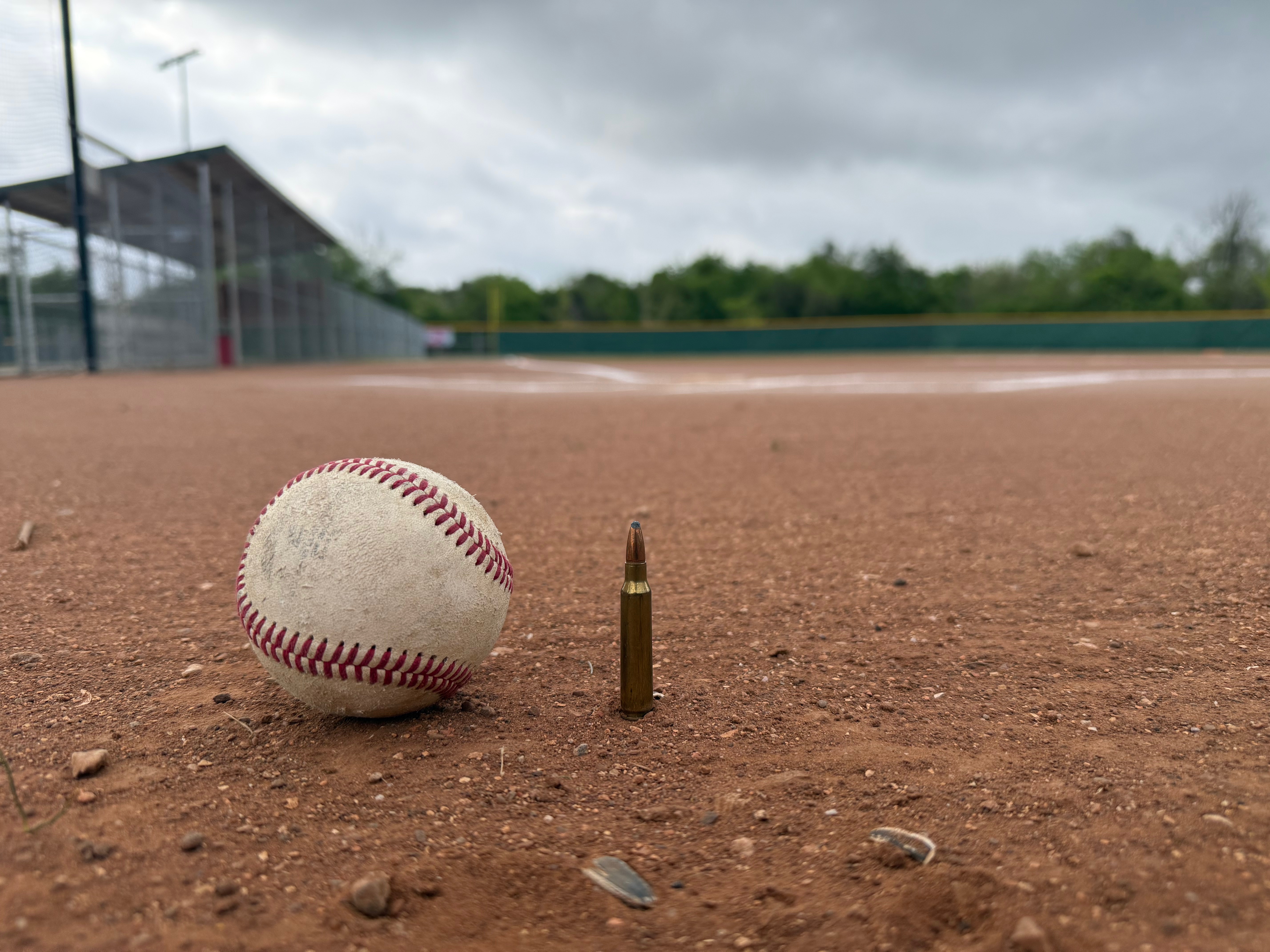
It was late April of 2004. The season had just started. I don’t remember who the Express were playing. I don’t remember the score. I don’t even remember who won. But I remember being at a minor league ballpark with my family and friends, and I remember that it was a beautiful spring day in central Texas. And I remember the feeling that I had no business being there at all. Four days earlier, give or take, I had been in Iraq.
I was a young squad leader with the 25th Infantry Division. We had gotten to Kuwait in mid-January. I had married my wife Tracy on January 3rd, which gives you some sense of the timing, and then convoyed north to Kirkuk, a complicated city in a complicated country. Kurdish in large part, and the Kurds were glad we were there, which made it feel less like an occupation than it was in other parts of the country. There were also plenty of people who were not glad we were there.
We weren’t exactly storming the beaches at Normandy or charging up the sands of Iwo Jima, but it was dangerous the way all long combat deployments are dangerous. Not every second, but enough that you could never let your guard down. IEDs were a weekly occurrence. Rocket attacks were nightly. People got hurt. People got killed.
A few days before the game, I had caught a ride on a C-130 from Kirkuk to Kuwait, then a commercial flight to the UAE, then another to Cincinnati, then Austin. I was going home for two weeks of R&R and I wasn’t happy about it. That’s a strange thing to say. My wife was home. My family was home. I wanted to see them. But it was too soon, and I knew it. We had barely started our mission, and I was a newly promoted corporal running a squad of infantrymen. My friend Colin had been severely wounded in Baghdad in March with another unit, wounds he would not survive. Two weeks after that, our battalion lost its first soldier killed in action, a young PFC from Charlie Company. Things were heating up. The thought of going home to sit on a couch for two weeks felt absurd in a way I couldn’t explain and didn’t try to. But it wasn’t my choice, so like a good soldier I followed orders, and a few days later I was in a baseball stadium in Texas, surrounded by civilians, a hotdog in one hand and a beer in the other, watching a minor league game that didn’t matter in the standings of anything.
It was surreal. The whole experience had the quality of something happening to someone else.
***
Baseball and war have been keeping company for a long time. Soldiers played it between battles in the Civil War and carried it home with them when the fighting was done, and by the time the country stitched itself back together, the game was already woven through it.
By World War II, baseball was the American game, and the war took it seriously. Ted Williams left after the 1942 season and came back, then went again for Korea, flying combat missions without complaint. Bob Feller enlisted the day after Pearl Harbor. Joe DiMaggio served three years. Hank Greenberg re-enlisted weeks after being discharged in December of 1941. These were the best players in the world, and they went.
The game didn’t belong only to the pros. Soldiers and Marines played it on airstrips in the Pacific and in fields in England and North Africa, most of them barely old enough to have left their hometown teams behind.
Vietnam was different. The country was divided in a way it hadn’t been before, and baseball didn’t send its stars the same way. But the game still followed the troops. Scores came through the Armed Forces Vietnam Network, which broadcast box scores through static to the men on firebases and forward positions, the same way everything else from home came through. And when they had downtime, they played.
Dozens of professional ballplayers still served, Nolan Ryan, Tom Seaver, Dusty Baker, usually in the reserves. Roberto Clemente had already done his time in the Marine Corps. Maybe that’s part of why, when the earthquake hit Nicaragua in 1972 and relief shipments were being stolen, he didn’t just send money. He got on the plane himself.
In Iraq, we didn’t have the equipment for actual baseball. What we had was a Chicago ball, one of those big 16-inch softballs you play without gloves. Somebody had gotten one in a care package from home. And somehow we had a bat. That was enough.
My unit, the 1st Battalion, 21st Infantry Regiment, the “Gimlets,” got our nickname in 1921 when a soldier named Eugene Riley organized the regimental athletic teams in Hawaii and they bored through everyone they played. A gimlet is a rock-drilling tool. Our motto is Bore Brother Bore. So sometime around the Fourth of July 2004, in the middle of an active combat deployment in Kirkuk, the Gimlets organized a sports tournament. Flag football, dodgeball, ultimate frisbee, grappling, and a full single-elimination Chicago ball tournament. We were operating out of Kirkuk Air Base, so there was plenty of open ground to make a field. Near third base there was a crater from a rocket impact the week before.
The teams came from the different platoons. The uniforms were what we had. Most teams wore their PTs or some mismatch of unit shirts and combat uniforms. Our Mortar platoon team wore DCU bottoms, desert camouflage from the waist down, high green socks, brown t-shirts with the mortar system stenciled on the front in black spray paint and numbers on the back, short-brimmed patrol caps. The baggy pants and the high socks made us look like a 1930s barnstorming team that had wandered through a war zone to get to the game. The Fighting 81s, named after the round our big guns fired, cut through the competition and made it to the finals against the Scout platoon.
What I remember most is that for the hours we were playing, we were just playing. The war was still there, it was always still there, but for a week, in between patrols and fire missions, we were arguing calls and talking shit and doing the thing American soldiers have done since the 1860s. They find a ball and they play.
That October, on a rare night off, a few of us crowded around a small television on base and watched the Red Sox come back from three games down against the Yankees. Dave Roberts stole second. Bill Mueller singled him home. David Ortiz walked it off. I’m a lifelong Astros fan, and we’d already been knocked out by the Cardinals, so I had nothing left but rooting against the Yankees on general principle, as usual. But it’s one of my favorite games I’ve ever watched, not just because of what happened on the field, but because of where I was and who I was with.
***
When people filled ballparks during the Second World War, it wasn’t because they were ignoring what was happening. It was proof that ordinary life was still there underneath it.
In his essay “The Green Fields of the Mind,” A. Bartlett Giamatti writes about the end of the 1977 season, the Red Sox fading in September, summer slipping away, the game stopping and leaving you to face the fall. He understood that baseball is designed to break your heart. But it also keeps coming back. The season ends and the season is born again, and it has done that through wars and depressions and everything else this country has put itself through.
The 2004 season kept going while I was in Kirkuk. I wasn’t tracking it every day, couldn’t always. But I knew the standings and I knew where the Astros were. The game was happening back home whether I had access to it or not, and there was something in that. Not comfort exactly, more like proof that the world I’d left was still running as it should. Somewhere people were arguing about the bullpen and complaining about the lineup and none of it had anything to do with what we were doing, and that distance was strange and also necessary, in some way I couldn’t have articulated then and maybe still can’t now.
W.P. Kinsella wrote in Shoeless Joe that the one constant through all the years has been baseball, that America has been erased and rebuilt over and over again, but baseball has marked the time. They put the line in the film and James Earl Jones delivered it and now every baseball fan knows it, because it’s true. Baseball may be one constant, but between reading American history and watching the news this morning, I’m reluctantly starting to think it’s not the only one.
***
Ted Williams came home from two wars and hit .388 in 1957 at age 38. Roberto Clemente lined a double off Jon Matlack for his 3,000th hit on September 30, 1972. He was dead on New Year’s Eve. In 2004, the Round Rock game ended and a few days later I was on a plane back to Iraq. The Fighting 81s lost in the final round of the Kirkuk Air Base tournament that summer. The Red Sox finally broke through that fall. Twenty-one seasons have come and gone since.
The smell of cut grass and raked dirt, a cold beer and a hotdog, the crack of a bat, the pop of a fastball finding a catcher’s mitt, the roar of a crowd. None of it fixes anything waiting outside the gates. But somewhere a grounds crew has finished dragging the infield, and later today those gates will open, the way they always have, the way it feels like they always will, whether things have gotten better or not. I’ll take it.
Nick Allison is a writer based in Austin, Texas. His work has appeared in Slate, HuffPost, CounterPunch, The Fulcrum, and elsewhere. (@nickallison80.bsky.social)
Discover more from the chaos section
Subscribe to get the latest posts sent to your email.


 the chaos section